Methodology for the End-of-First-Life Inbound Forecast
Bathtub-curve modelling for inbound planning
End of first life is when a product leaves its first use phase and enters reverse logistics: repair, reuse, remanufacturing, recycling, or disposal. Forecasting inbound failure volumes years ahead helps recyclers, disassembly operators, and designers plan capacity and recovery routes.
The REMASC inbound forecast uses a bathtub-curve lifetime model: early failures, a period of roughly constant hazard, and wear-out behaviour driven by cohort-specific parameters in your workbook. Monte Carlo uncertainty for life span (e) and standard deviation (f) is defined in the template Excel columns; other parameters use built-in perturbation rules. Total failed quantity per year is simulated many times to produce percentile bands.
Low, middle, and high scenarios use different wear-out age bands and constant failure rates (shorter vs longer expected lifetimes). Each scenario has its own MC workbook filename; upload the file that matches the case you want to analyse.
The stacked bars show how failures split across car models (or other cohort labels in your sheet) from 2020 onward. The overlaid box plots show the distribution of total failed units from Monte Carlo runs (whiskers at P5 and P95).
Use this tool for strategic planning, for example EV motor or battery inbound failure flows. It is not a substitute for regulatory compliance checks on its own. Review inputs and assumptions with domain experts before relying on the results.
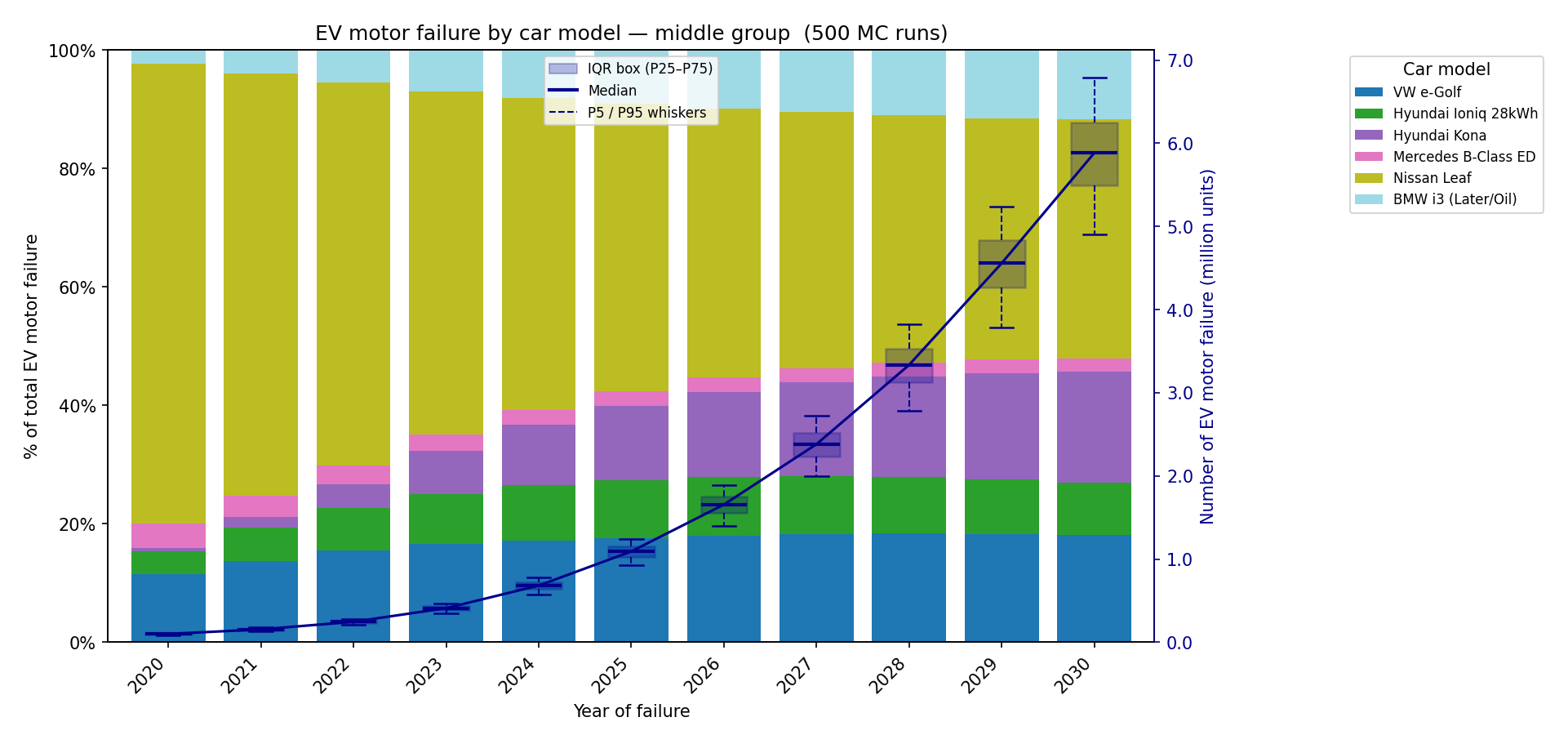
Example output for the middle scenario (deterministic composition and Monte Carlo failure quantity bands).