Design for ReX Cards
Design for Ease of (Robotic) ReX Guidelines
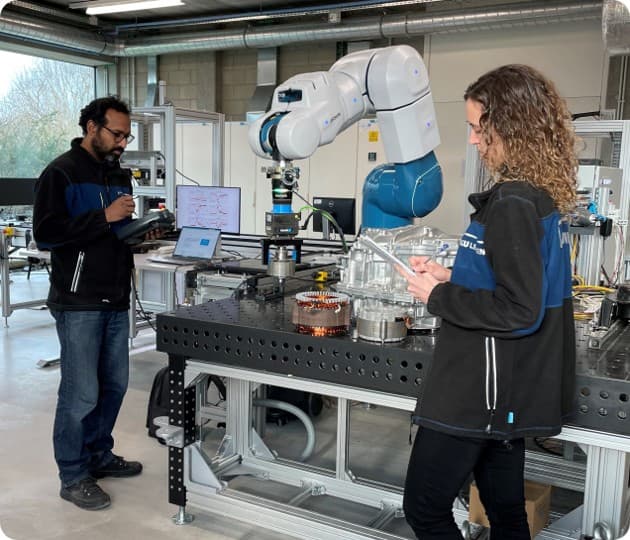
Human-robot cooperative workstation for product demanufacturing
By facilitating ReX-strategies, such as reuse, repair, refurbishing, remanufacturing, and recycling, resource efficiency can be maximised, and negative environmental impacts can be reduced. The successful and efficient demanufacturing, the inverse of manufacturing, is essential for the success and economic viability of these ReX-strategies. The complexity of the demanufacturing process is often overlooked when only focusing on the (robotic) disassembly, as other demanufacturing activities, such as product and component identification, condition evaluation, functional testing, repair, resetting, and sorting, are of equal importance for the success of ReX strategies. Therefore, Design for Ease of (Robotic) ReX targets product design strategies that enable straightforward, non-destructive, successful, and cost-efficient execution of the wide variety of demanufacturing activities at the end of a product's (first) life.
Unlike manufacturing, which is typically centralised and scaled for mass production, demanufacturing requires more flexible systems to handle the high variation across product generations and conditions, and more distributed systems considering the high cost of (individualised) reverse logistics and legislative constraints of cross-border shipments of discarded products. Considering this, Human-Robot Cooperative Systems combine the dexterity of manual handling with the speed and consistency of robots, offering opportunities to increase the economic viability of enhanced decentralised ReX-strategies.
To maximise the economic viability, the automation level is also to be maximised, for which the product design is a crucial determinant of what and how the robot can perform distinct operations and to what extent human interventions are still required. The developed design guidelines build on practical insights gained at the KU Leuven Re- & Demanufacturing Lab, accounting for realistic constraints of a futuristic human-robot cooperative cell. The reference robotic cell includes:
- a conveyor system,
- a clamping module,
- a vision system, and
- a robotic arm equipped with generic unscrewing tools and a parallel finger gripper.
Whereas customised components and tooling can always be developed for specific product designs, customisation is not expected to be feasible for decentralised Rex for the vast majority of products. Therefore, the elements of the reference robotic cell are used to define the operational boundaries that influence which geometric features, visibility cues, material choices, and connector designs facilitate or hinder human-robot cooperative ReX strategies.